
Fresh Batch #202: Cadmus, The So-called Phoenician Who Is Nothing More Than a Greek Lie
Do You Find It Strange That Europe Is Named After Greek Fiction?

Jacob Bryant wrote (Analysis Ancient Mythology, pp. 138-9.), “Although I have said so much about Dionusus, Sesostris, and other great travelers, I cannot quit the subject till I have taken notice of Cadmus: for his expeditions, though not so extensive as some, which I have been mentioning, are yet esteemed of great consequence in the histories of ancient nations. The time of his arrival in Greece is looked up to as a fixed æra: and many circumstances in chronology are thereby determined. He is commonly reputed to have been a Phenician by birth; the son of Agenor, who was the king of that country. He was sent by his father’s order in quest of his sister Europa; and after wandering about a long time to little purpose, he at last settled in Greece. In this country were many traditions concerning him; especially in Attica, and Bœotia. The particular spot, where he is supposed to have taken up his residence, was in the latter province at Tanagra upon the river Ismenus. He afterwards built Thebes: and wherever he came, he introduced the religion of his country. This consisted in the worship of Dionusus (the sun); and in the rites, which by the later Greeks were termed the Dionusiaca.

“They seem to have been much the same as the Cabyritic mysteries, which he is said to have established in Samothracia.”
According to Encyclopedia Britannica, the Cabeiri are possibly of Pelasgian or Phrygian origin. In previous posts, we’ve shown how Parez, or Perez, was a title of the sun-deity, which is incorporated into Perseus and Persians. Given the L and R interchange in different cultures connected to this system, it is not a stretch to imagine that the root of Pelasgian, which is Pelas, could be Peras. Even of more consequence, given that the P and B interchange, you then have in Pelas and Parez, the name of Belus, or Baal, seen in ancient locations like Baalbek, the city of the sun.
I included the following quote in The Real Universal Empire, “Myrsilius of Lesbos does not call the people Pelasgians, but Tyrrhenians (Italians; Etruscans). And the same people were called by the rest of the world both Tyrrhenians (Italians; Etruscans) and Pelasgians.”
I personally don’t know how anyone can confuse this subject. It is so easy to see that Phoenician is the same word as Venetian, and that the people of that region spoke Etruscan. I wrote (TRUE), “There were Venetians in the northern part of the Adriatic who, though their names were Venetian, only spoke Etruscan. They did not speak the Indo-European Venetian. (Brendel, p. 256; A. J. Pfiffig, Sprach, VIII (1962), pp. 149-153.)”
As you can see from the following Michael Grant citation, the basis of the German and Scandinavian runes comes from Clusium by way of Venetia.
It’s obvious why the Irish, Basque, and other peoples of Europe still use purely Etruscan words. They are a diaspora of the ancient Italians. Col. Vallancey wrote, “The Etruscan name of Jupiter was iu-primus atar; and thus primus atar was contracted to p. atar, all from the Phœnician priomh athair, first father (note the correspondence to Prometheus, which, if the P is removed, becomes Strong God or God of Rome); hence the Greek pater, and pateros; Lat. pater; Bisc. aita; Gothic atta; Thessal. atta; Persic, padder, &c.”
It looks like Iu-Primus Atar would signify God the First Father. Vallancey didn’t mention the Sanskrit counterpart of pater, which is pitar, also meaning father, and if it comes from Etrusco-Phoenician, it is more evidence that this system is from Italy. He observed aita is the Biscayer (Basque) word for father. This word is seen inscribed next to Suri on Etruscan tombs in Italy, which would make Suri, meaning black or darkness, Father Time, or Father Death, the sun in winter, just like Lycian Apollo, and this is further signified by the wolf, an animal sacred to Mars and Apollo, because wolves are most active in winter. This is the likely origin of the Norse Surtr as well. The Basque people using an Etruscan word for father is even more evidence of an Italian origin and diaspora, not an oriental one.

Also note that aita (eye-tuh) signifies priest, as well as author, which is a creator or maker.

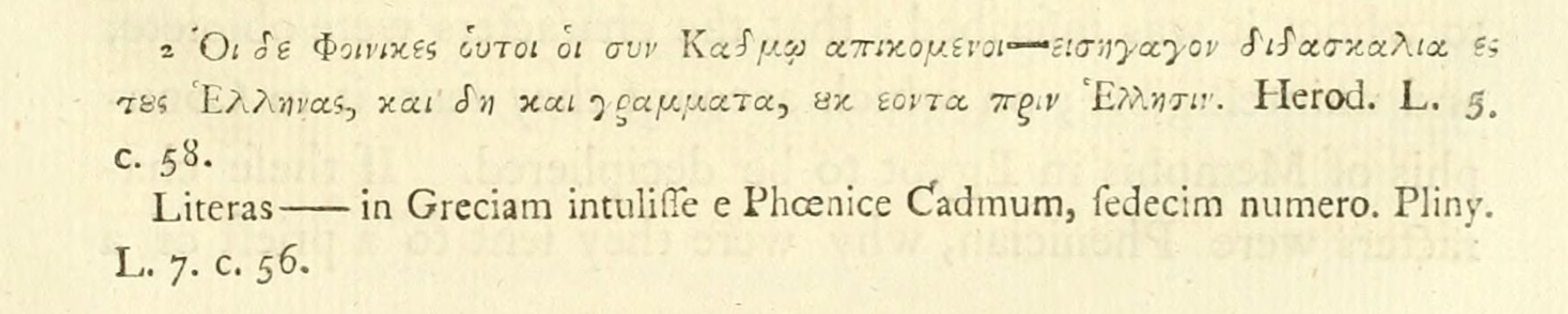
Bryant continued (Ib. p. 139.), “He (Cadmus) fought with a mighty dragon; whose teeth he afterwards sowed, and produced an army of men. To him Greece is supposed to have been indebted for the first introduction of letters; which are said to have been the letters of his country Phenicia, and in number sixteen.
“He married Harmonia, the daughter of Mars and Venus (Harmony, the peace between love and war; Virgo with her scales of Libra, the balance between summer and winter, of heaven and hell): and his nuptials were graced with presence of all the Gods, and Goddesses; each of whom conferred some gift upon the bride. He had several children; among whom was a daughter Semele, esteemed the mother of Bacchus. After having experienced great vicissitudes in life, he is said to have retired with his wife Harmonia to the coast of Illyria, where they were both changed to serpents. He was succeeded at Thebes by his son Polydorus, the father of Labdacus, the father of Laius. This last was the husband of Jocasta, by whom he had OEdipus.”
I suspect that those believe those accounts were historical suffer from unimaginable childlike delusion, or get their rocks off seeing how others could succumb to the belief in those stories as literal history. The following is where the institutional Mosaic narrative appears take its grip on the stories, which were already in rooted in the absurd. Bryant wrote (Ib. p. 139.), “Bochart (17th Century AD) with wonderful ingenuity, and equal learning, tries to solve the ænigmas, under which this history is represented. He supposes Cadmus to have been a fugitive Canaanite, who fled from the face of Joshua: and that he was called Cadmus from being a Cadmonite, which is family mentioned by Moses. In like manner he imagines, that Harmonia had her name from mount Hermon, which was probably in the district of the Cadmonites. The story of the dragon he deduces from the Hevæi, or Hivites; the same people as the Cadmonites.”
Again, (Ib.), “I cannot be induced to think, that Cadmus was, as Bochart represents him, a Phenician. Indeed I am persuaded, that no such person existed. If Cadmus brought letters from Phenicia, how came he to bring but sixteen; when the people, from whom he imported them, had undoubtedly more, as we may infer from their neighbours? And if they were the current letters of Greece, as Herodotus intimates; how came it to pass, that the tablet of Alcmena, the wife of Amphitryon, the third in descent from Cadmus, could not be understood, as we are assured by Plutarch?

“He says, that in the reign of Agesilaus of Sparta, a written tablet was found in the tomb of Alcmena, to whom it was inscribed: that the characters were obsolete, and unintelligible; on which account they sent it to Conuphis of Memphis in Egypt to be deciphered. If these characters were Phenician, why were they sent to a priest of a different country for interpretation? and why is their date, and antiquity defined by the reign of a king in Egypt? Τους τυπους ειναι της επι Πρωτει βασιλευοντι γραμματικης. The form of the letters was the same, as was in use, when Proteus reigned in that country. (Plutarch. Ib.) Herodotus indeed, to prove that the Cadmians brought letters into Greece, assures us, that he saw specimens of their writing at Thebes in the temple of Apollo Ismenius: that there was a tripod as ancient as the reign of Laius, the son of Labdacus; with an inscription, which imported, that it had been there dedicated by Amphitryon upon his victory over the Teleboæ.

“I make no doubt, but that Herodotus saw tripods with ancient inscriptions: and there might be one with the name of Amphitryon: but how could he be sure that it was the writing of that person, and of those times? We know what a pleasure there is in enhancing the antiquity of things; and how often inscriptions are forged for that purpose. Is it credible, that the characters of Amphitryon should be so easy to be apprehended, when those of his wife Alcmena could not be understood? and which of the two are we in this case to believe, Herodotus, or Plutarch? I do not mean that I give any credence to the story of Alcmena, and her tablet: nor do I believe, that there was a tripod with characters as ancient as Amphitryon. I only argue from the principles of the Greeks, to prove their inconsistency. The Pheneatæ in Arcadia showed to Pausanias an inscription upon the basis of a brazen statue, which was dedicated to Poseidon Hippius. (Pausanias. L. 8. p. 628.) It was said to have been written by Ulysses; and contained a treaty made between him and some shepherds. But Pausanias acknowledges, that it was an imposition: for neither statues of brass, nor statues of any sort, were in use at the time alluded to.”
The following is an excerpt from The Holy Sailors, which members have full access to, “Davies wrote, ‘They do not seem to have augmented the number of letters. Only sixteen are ascribed to Cadmus. The same number is claimed by the old Latins, by the old Germans, by the Irish, and by the British bards.’
“The Welsh letters, though 36 in number, are only sixteen of them radical, and almost entirely the same as the Etruscan, which may explain the affinity of the Welsh to Hebrew, however it must be recalled that, although the Hebrew took the letter system from Etruscans and Phoenicians, the Etrusco-Phoenician language has its affinity to the Celtic, not the Hebrew.
“Rev. Smith (Hist. Drui.) wrote, regarding the writing of the Gaelic or Irish alphabet, ‘This alphabet consists exactly of the sixteen letters which Cadmus brought from Phoenicia (to Greece) about 1400 years before the birth of our Saviour, with only the addition of the letter F and the aspirate which was expressed with only a dot above the line. Now, if this alphabet had not been borrowed at least before the time of the Trojan War, when Palamedes made the first addition to it, we can hardly conceive it should be so simple.’
In the previous book, A Godsacre for Winds of the Soul, I wrote, “Col. Wilford recognized that the Sanskrit alphabet, when stripped of the double letters and the ones unique to it, has the same sixteen letters as the letters of the Pelasgi or Cadmus (Asiat. Res. Vol. VIII. p. 265.). It seems the common variable in all of this is the Phoenicians, bringing the languages with them, neither conquering nor being conquered, but through commerce.”
I wrote in The Real Universal Empire, “Astle wrote (Orig. Prog. Writ. p. 53), ‘The Etruscan letters are Pelasgic, and several of the Etruscan inscriptions are written in the Pelasgic language. The Oscan language was a dialect of the Etruscan: their characters are nearer the Ionic, or Roman, than the Etruscan. There is very little difference between the Pelasgian, the Etruscan, and the most ancient Greek letters, which are placed from right to left.’
“The Oscan alphabet is the 16-letter system, but if the more modern letters are removed (B because it was interchangeable with V, Ch which is equivalent to the Greek Chi, the F or Digamma because it interchanges with several letters including the V, W, Y, etc., and the H because it was an aspirate), then a 12-letter alphabet remains. But if the digamma were included instead of the V, as well as H for the aspirate, then the Oscan alphabet would consist of thirteen letters.
“The Coptic is claimed by some to originate from the vulgar Egyptian while others claim it is an immediate descendant of the Greek, which gave way to the Ethiopian. The Ethiopian shares over 500 root words with Hebrew, which does not prove its antiquity but instead demonstrates its youth. If the languages are reliable, the Indian influence in Ethiopia and Egypt is modern. No historian noticed the Rosetta Stone during the era it was claimed to be created in. The three languages on the Rosetta Stone are Hieroglyphics, Coptic, and Greek, which are all of Greek origin and have nothing to do with older languages like Phoenician, Pelasgian, or Etruscan. There were no hieroglyphics on the megalithic structures when they were originally found, including the Great Pyramids. These details indicate the hieroglyphics are modern compared to the ancient alphabets.”
Higgins wrote (Celt. Dru. p. 23), “If what Gorius and Swinton say can be depended on, that the ancient Etruscan alphabet had only thirteen letters, it seems fair to conclude, that the Etruscans were settled in Italy, or that they had letters, before any of those nations which are found to have had sixteen or seventeen. It will then follow, according to the present hypothesis, that the Eastern nation from whom they came had at first only thirteen ; that after the Etruscan colony came to Italy the Cadmean or Eastern nation or Celts, Κελτοι, increased their letters to seventeen. It is probable that the nation amongst whom the fewest and most simple letters are found will be the oldest. On this principle, the Etruscans, being a colony, must have come direct from the oldest nation.”
Fresh Batch #10: There's a Problem with a "Greek" God. Can You Figure It Out?

Fair Use: Images are for educational purposes.
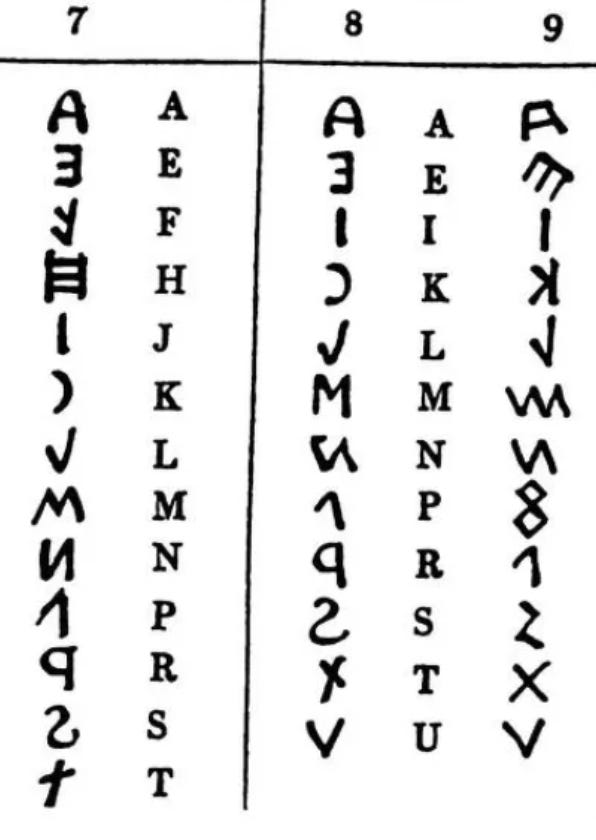
There is no trace of the Greek names in Etruscan or Latin letters, which supports my claim that they didn’t descend from Greek.
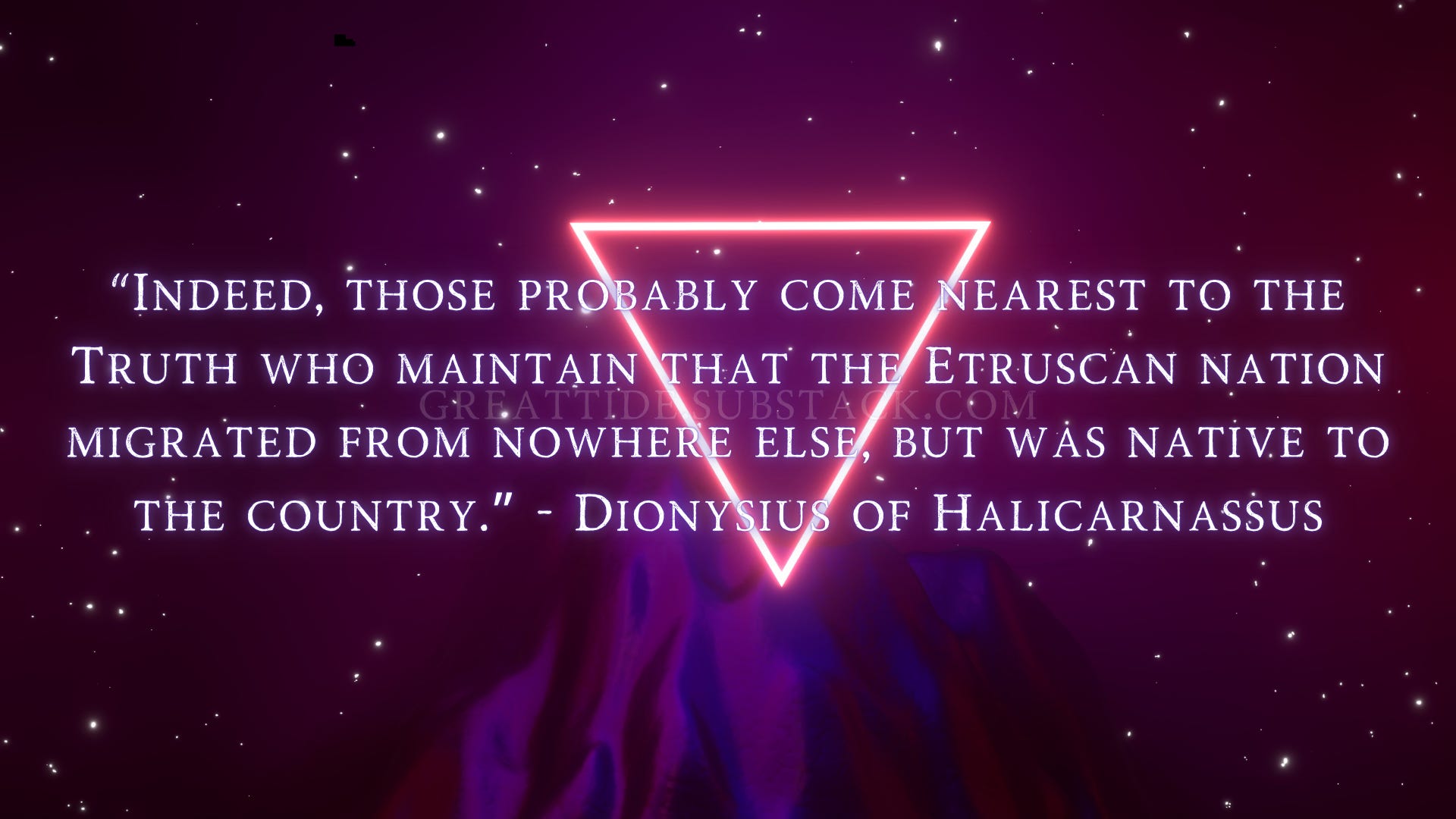
If you refer to the above quote from Dionysius of Halicarnassus, that the same people were called by the rest of the world both Tyrrhenians and Pelasgians, then the solution is apparent and simple. This originated with the Etruscans. To see how I arrived at these conclusions, and to learn how to take apart the historical narrative on your own, read the Spirit Whirled series and then The Real Universal Empire.


Become a member to access the rest of this article.
Keep reading with a 7-day free trial
Subscribe to Ancient History, Mythology, & Epic Fantasy to keep reading this post and get 7 days of free access to the full post archives.